

Deterministic code checks
Not every check needs an LLM. When the rule is deterministic, for example “is this valid JSON?” or “is the response under 280 characters?” or “does it match this regex?”, a code grader is faster, free, and perfectly consistent.
This walkthrough builds a code grader that checks whether a support-ticket classifier returns well-formed JSON. It is the running example for the customer-support evaluators in Weighted-average scoring and Route failures to human review.
When to use a code grader
The grader function
A code grader is a Python main(eval_inputs) function that returns a score. eval_inputs["output"] is always available; input, expected_output, metadata, and metrics are there when the run supplies them (see Where grader inputs come from).
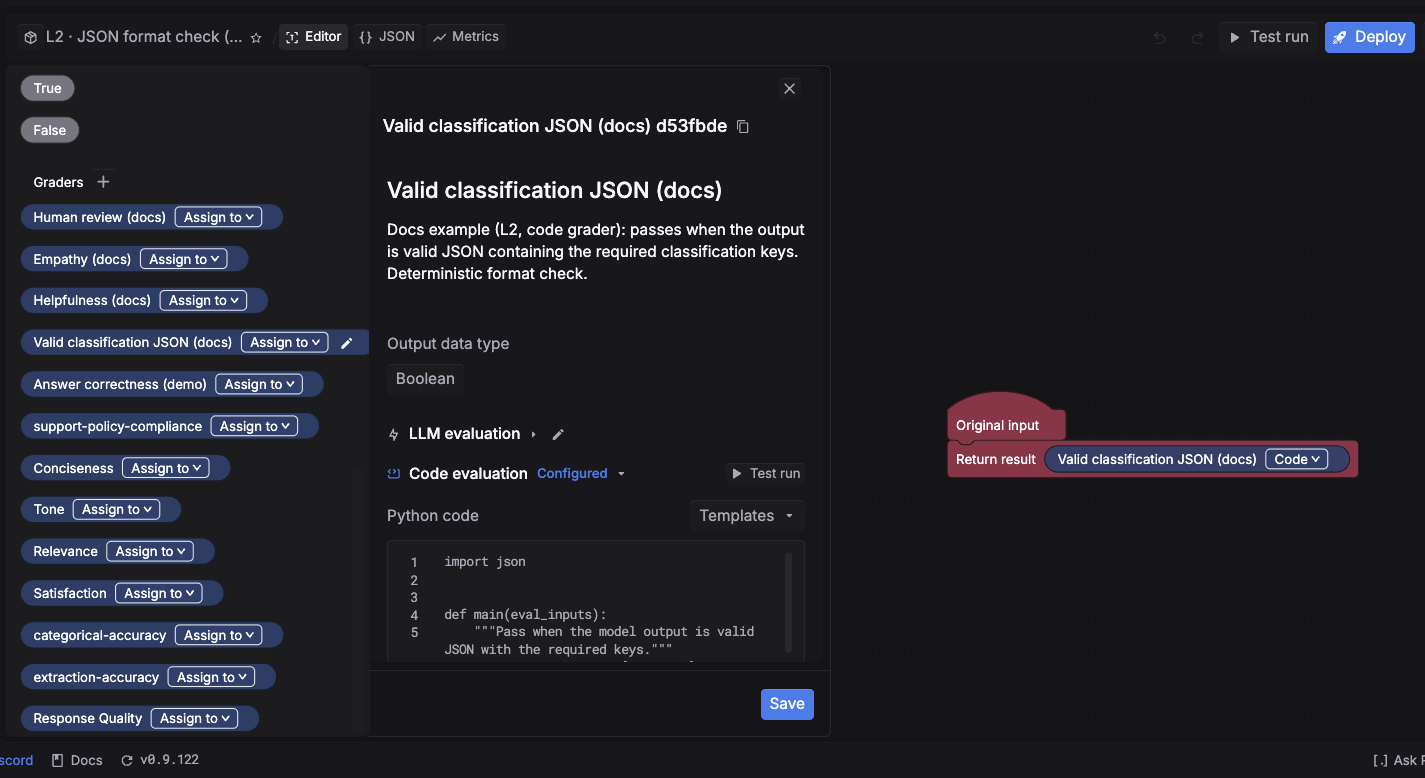
The function returns a boolean, so the grader’s output type is Boolean: true passes, false fails.
eval_inputs["output"] can arrive either as a JSON string or as an already-parsed object, depending on how the run captured it. The check above handles both: it parses strings, and treats anything that is not a JSON object as a fail.
Walkthrough
Create the code grader
In the Graders section, add a grader named Valid classification JSON and set the output type to Boolean. Switch to Code evaluation and paste the main(eval_inputs) function above. Use Templates if you want starter code for a common pattern.
Test both outcomes
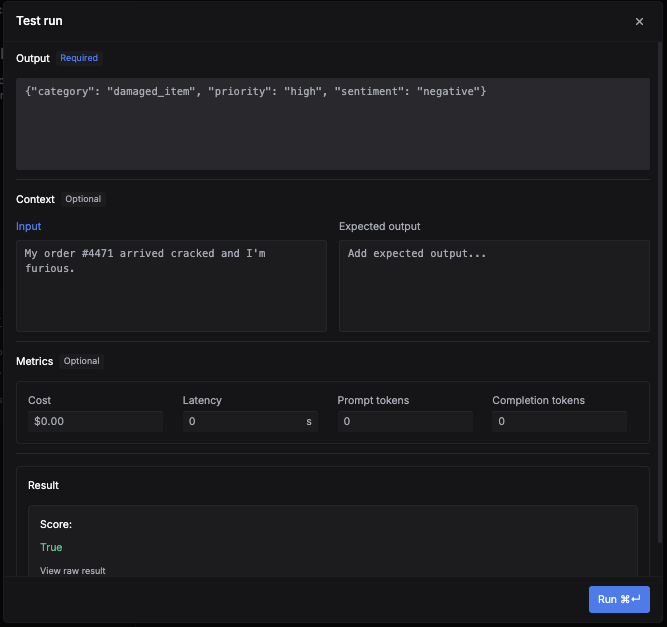
Click Test run with a passing output and a failing one to confirm both branches.
- Output
{"category": "damaged_item", "priority": "high", "sentiment": "negative"}returnstrue. - Output
Sorry to hear that! I'll help you sort this out.returnsfalse.
What’s next
- Weighted-average scoring. Combine this format check with an LLM quality score.
- Route failures to human review. Escalate low-scoring outputs to a person.
- Back to the Evaluators overview.